VULKAN · LIVE
Per-matmul offload
Stage one: the projections of the chosen layers run on the device. Attention, norms and the KV cache stay on the CPU. Always available.
STAGE 1One Vulkan compute backend so the same engine runs faster on NVIDIA, AMD and Intel graphics, on Windows and Linux first. The model file and the CPU path stay untouched.
Stage one: the projections of the chosen layers run on the device. Attention, norms and the KV cache stay on the CPU. Always available.
STAGE 1Stage two: a run of layers executes entirely on the device, with attention over a device-resident f16 KV cache. One submit per forward pass.
STAGE 2Opt-in: the device gets a smaller copy of the weights so more layers fit in VRAM. The GGUF and the CPU path are not changed.
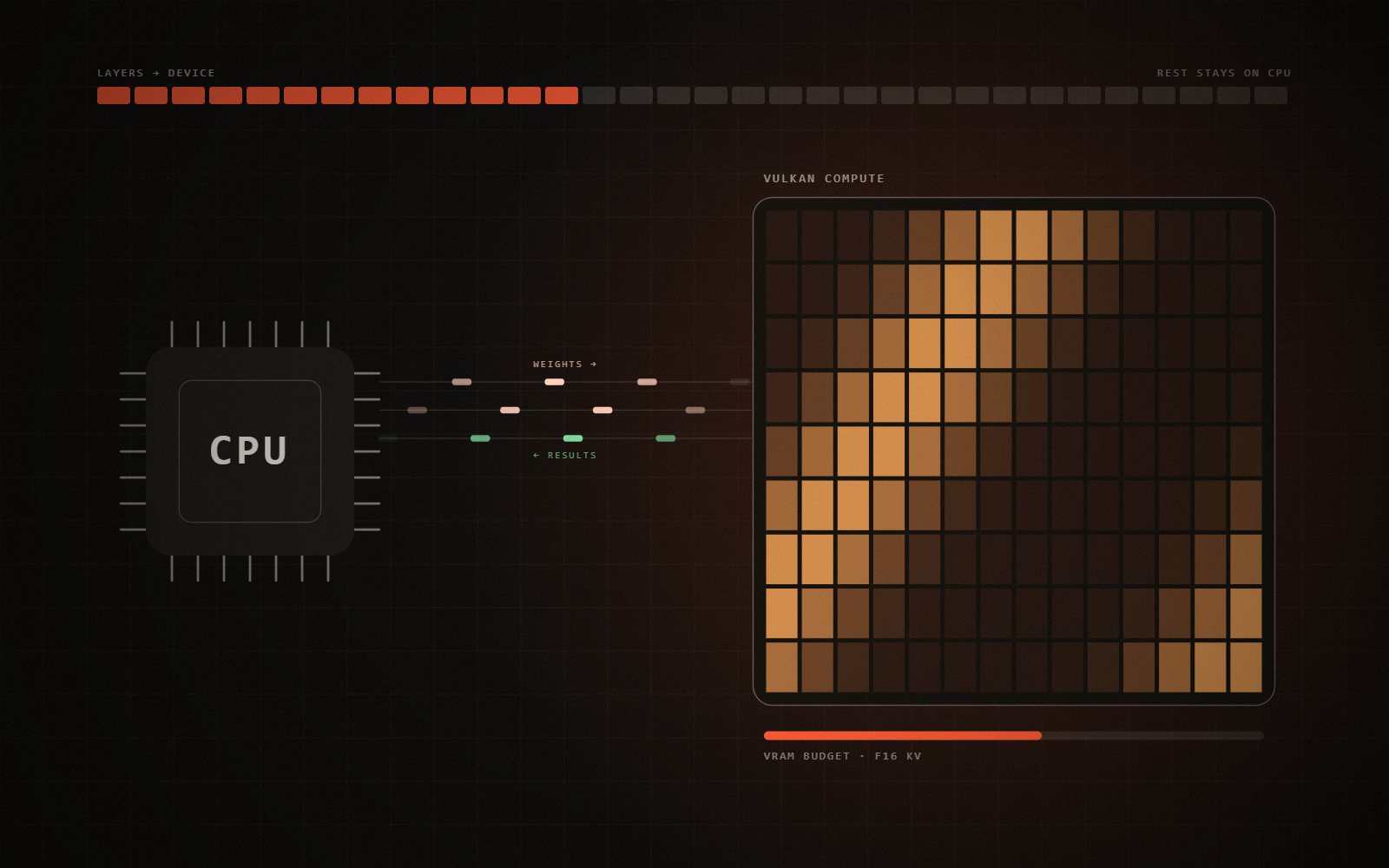
OPT-INThe engine decides how many layers fit the card's memory budget and keeps the rest on the CPU.
AUTOStep 1
The Vulkan loader finds a usable device at runtime.
Step 2
Layers are assigned to the GPU until the VRAM budget is used.
Step 3
Weights for those layers are copied, optionally re-quantised.
Step 4
Each forward pass crosses the bus once each way.
 01 / 05
API
Vulkan compute, GLSL shaders
Per-matmul offload of the heavy projections
Whole-layer spans on the device with an f16 KV cache
Opt-in re-quantisation so more layers fit in VRAM
FROM IDEA TO RELEASE

Founder & maintainer
The founder’s storyOpen-source contributors
Fork the repoor just email support@imutechz.in